Foreigner's Guide to Buying a Condo in Bangkok: Legalities, Process & What to Avoid
Navigate the legal landscape and secure your dream property in Thailand.
 BANGKOK CONDO: SIMPLIFIED & SECURE. Your complete guide to Thai property ownership
Bangkok, the vibrant capital of Thailand, continues to be a magnet for foreigners seeking both an exciting place to live and a promising investment opportunity. Its thriving economy, attractive lifestyle, and relatively affordable property prices make it a top choice. However, as a foreigner, buying a condo in Bangkok comes with specific legalities and a distinct process you need to understand.
This comprehensive guide will walk you through everything you need to know to navigate the Thai property law for foreigners, helping you secure your dream condo ownership in Thailand smoothly and safely.
1. Understanding Foreigner Condo Ownership in Thailand: The 49% Rule
The cornerstone of foreigner's condo ownership in Thailand is the Condominium Act. Unlike land, which cannot be owned freehold by foreigners (with very few, complex exceptions), foreigners can own condominium units freehold, subject to certain conditions.
The most crucial rule is the "49% foreign ownership quota":
- Total Ownership: The total area of all condominium units owned by foreigners in a specific condominium project cannot exceed 49% of the total saleable area of all units in that project.
- Proof of Funds: The funds used to purchase the condo must be remitted into Thailand from overseas in foreign currency and exchanged into Thai Baht by a licensed financial institution in Thailand. This is typically evidenced by a Foreign Exchange Transaction Form (FETF) or e-FETF (for amounts $50,000 USD or more) from the receiving bank. This document is absolutely vital for registration of ownership.
Understanding and adhering to the 49% quota and the FETF requirement is the first, non-negotiable step in your journey to buying property in Thailand as a foreigner.
2. The Step-by-Step Bangkok Condo Legal Process
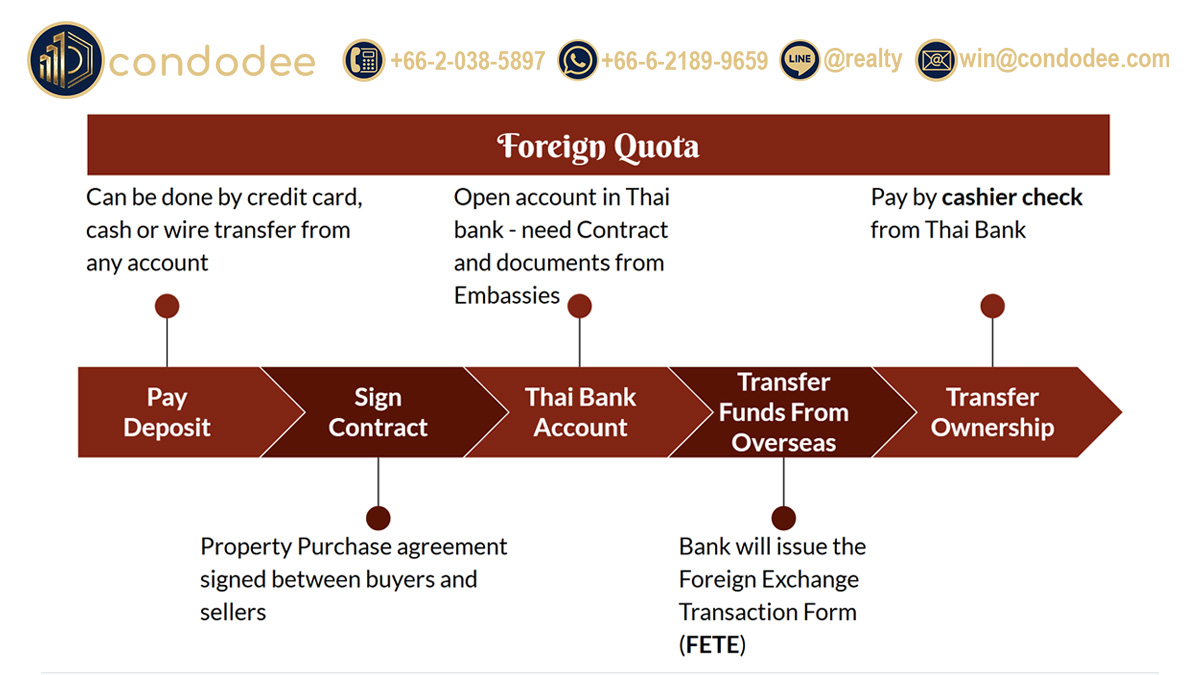 This infographic provides a clear visual representation of the essential legal steps involved in purchasing a condo in Bangkok, specifically tailored for foreign buyers. It outlines stages from initial due diligence and legal review to contract negotiation, payment transfer, and final ownership transfer at the Land Department, aiming to simplify the Bangkok condo legal process
Once you've identified your ideal condo, the Bangkok condo legal process typically follows these key stages:
2.1. Reservation Agreement & Deposit
- Purpose: To take the unit off the market and secure your interest.
- What to expect: You'll sign a Reservation Agreement and pay a small, non-refundable deposit. This is a preliminary step, not the final contract.
2.2. Due Diligence
- Purpose: To verify the legal status of the property and the developer/seller.
- What to expect: Before signing a Sale and Purchase Agreement, thorough due diligence for your Bangkok condo is critical. This should ideally be conducted by a reputable property lawyer. They will check:
- The developer's legitimacy and financial standing.
- The land title deed and building permits.
- The condo's common area management.
- That the 49% foreign quota is still available.
- For any encumbrances (mortgages, liens) on the property.
2.3. Sale and Purchase Agreement (SPA)
- Purpose: The legally binding contract outlines the terms of the sale.
- What to expect: Your lawyer will review and often draft or amend this agreement to protect your interests. It will detail:
- Purchase price and payment schedule.
- Unit specifications and common area fees.
- Transfer date and conditions.
- Default clauses for both parties.
- Warranty periods for new developments.
2.4. Payment Schedule
- Purpose: To make payments according to the SPA.
- What to expect: For new developments, payments are often phased (e.g., initial deposit, down payment, installment payments during construction, final payment upon completion). For resale, it's typically a deposit followed by a final payment. Remember, all funds must be remitted from overseas with the necessary FETF.
2.5. Transfer of Ownership at the Land Department
- Purpose: To officially register you as the new owner.
- What to expect: This is the final and most crucial step. You (or your legal representative with a power of attorney) and the seller/developer will meet at the Land Department. You will present:
- Your passport.
- The original FETF documents.
- The completed SPA.
- Any other required documents (e.g., marriage certificate if applicable, translated if not in Thai).
- All applicable taxes and fees (transfer fee, stamp duty, specific business tax if applicable, withholding tax).
- Upon successful registration, a new title deed will be issued in your name, and you will receive a copy.
3. What to Avoid: Common Pitfalls for Foreign Buyers
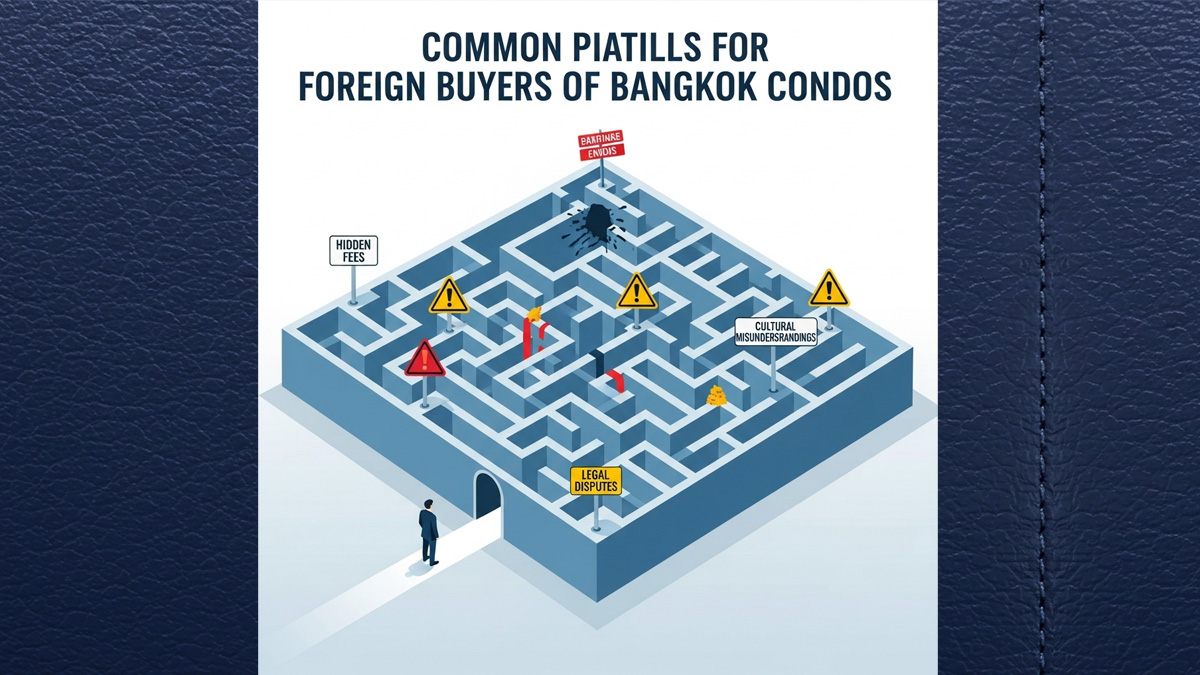
While the process is clear, several common pitfalls can trip up unsuspecting foreign buyers:
- Relying Solely on the Developer/Agent: While many are reputable, their primary duty is to the seller. Always seek independent legal advice.
- Ignoring the FETF Requirement: This is a non-negotiable legal requirement for foreign freehold condo ownership. Without it, you cannot register the title deed in your name.
- Skipping Due Diligence: Never sign an SPA or make significant payments without proper legal checks on the property and seller.
- Not Understanding All Costs: Beyond the purchase price, factor in transfer fees, stamp duty, potential specific business tax, common area fees, sinking fund contributions, and legal fees.
- Verbal Agreements: Thailand's property law requires agreements to be in writing. Do not rely on verbal promises.
- Attempting Nominee Structures for Land: Be extremely wary of advice to use Thai nominees or companies to own land freehold. These structures carry significant legal risks and are generally illegal under the Land Code. Stick to freehold condo ownership or long-term leaseholds for land if you're not a Thai national.
- Not Having a Will: Consider having a Thai will to ensure your property is distributed according to your wishes in Thailand.
Conclusion: Your Secure Path to Bangkok Condo Ownership
Buying a condo in Bangkok as a foreigner is achievable and can be a rewarding experience for both living and investment. By understanding the legal framework, meticulously following the process, and being aware of potential pitfalls, you can ensure a secure and smooth acquisition.
Always engage with trusted, independent legal counsel and reputable real estate professionals like CondoDee to guide you through every step. For a more detailed comparison of different property types in Bangkok or to explore properties in top neighborhoods like Sukhumvit or Sathorn, check out our other guides. Your Bangkok dream property awaits! Alternatively, explore our latest condo listings today.
Contact CondoDee
For serious inquiries about purchasing this luxury house at Vi Ari, please get in touch with CondoDee. Our team of experienced real estate professionals is ready to assist you in finding your dream home.- Office: 2nd Floor, 50 Sukhumvit 15, Khlong Toei Nuea, Watthana, Bangkok 10110
- Phone: +66 2 038 5897
- Mobile/WhatsApp: +66 62 189 5698
- LINE Official: @realty
- Email: win@condodee.com
More Real Estate News

Relocating to Bangkok from Dubai: Property Guide for High-Wealth Expats

Series 1: Global Reality Check — How Expensive Is the World Really?

Why and How to Choose a Real Estate Broker in Bangkok (Foreign Buyer Edition)

Why Condo Prices Differ So Much in the Same Location in Bangkok

Elections, Border Tensions, and Bangkok Property in 2026 — Understanding the Real Impact on the Market

Best Luxury Houses for Sale in Bangkok’s Northern Corridor 2025 | บ้านหรูสำหรับขายในโซนเหนือของกรุงเทพฯ 2025

Bangkok vs. New York, Singapore & Hong Kong: The Real Cost of Owning Property in 2025