
The 49% Rule for Thai Condos: Foreign Quota and FET Form
Foreigners generally can't own land in Thailand. But foreigners can own a condo unit in Bangkok or Phuket, Pattaya, or Chiang Mai. We are asked questions from foreign buyers all the time: how much foreign quota is left in the building? Which money papers does the Land Office ask for?
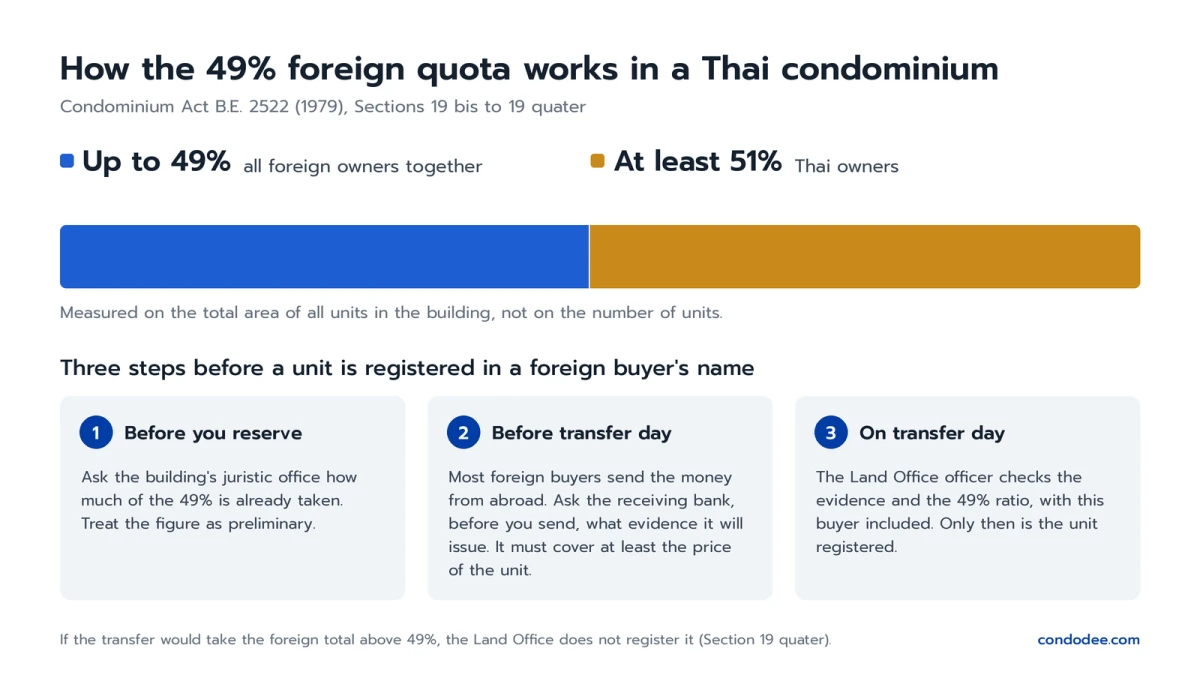
The short answer is that foreigners together may hold up to 49% of the area of all units in a building. That means if the building has 100 square meters of units in total, then foreigners can own 49 square meters of it. And as for the money papers, it depends on the buyer's group under Section 19 of the Condominium Act. Most of our foreign buyers send the money from abroad and show bank evidence that foreign currency came in, for at least the price of the unit.
What is the foreign quota for condos in Thailand?
The answer is very simple: foreigners together may hold up to 49% of the area of all units in one condominium, but not more than this. As of November 2026 the rule is 49% of the total area of all the units, not 49% of the number of units. So at least 51% of that area stays with Thai holders. This rule is written into Condominium Act B.E. 2522 (1979), Section 19 bis.
A term "Foreign Quota" is an expression that is not used in the Condominium Act. In the Act we can read about the rate of 49%, and this is what the Land Office checks. The foreign quota available is the unit area a foreigner can take without the foreign total going above 49%.
But keep in mind that this is just an ownership of the unit. And it's 100% in the buyer's own name. The steps of a purchase are written in the foreigner buying guide.
Who checks the foreign quota, and when?
The answer is that the Land Office officer checks it on transfer day. Section 19 ter of the Condominium Act says that the party transferring the unit must tell the officer the names of the foreign holders and the share of the unit area they already hold. Then the officer will register only if the evidence is correct and the foreign total, including this buyer, stays within 49% (Section 19 quater).
In reality, you will get a first figure from the building's juristic person before the transaction begins. The building's juristic office will give this information, but we treat it as preliminary.
So why does the order matter? Because a figure from the building's juristic office or from our own listings is just information for your decision. But the registration is decided at the Land Office on transfer day, and that's where the officer checks that the foreign total stays within 49%.
How can you tell whether a unit is inside the foreign quota?
The answer is that you can tell by looking at the listing text, asking the juristic office, and then by the Land Office's check on transfer day. Of our 707 listings in completed buildings, 405 (57%) state foreign freehold quota in their text. Only two state Thai quota only. And 300 (42%) do not state it.
We looked at our own listings for sale in Bangkok as of 3 November 2026. Our sample included 766 active CondoDee sale condos in Bangkok with price and size. Of those, 707 were in buildings that were completed as of November 2026, called completed-building listings. We used the current status of each project, completed, under construction or off-plan, and not the completion year alone. So 41 of the 707 are in ten buildings with a completion year of 2026, because those buildings are already completed. This may include unsold developer units, and our numbers don't represent the entire market. We didn't include the 56 listings in buildings that are under construction or off-plan, which are shown apart, or 3 listings with no project page and no construction year (707 + 56 + 3 = 766).
For the completed-building listings, we read the text of each listing page to find out what it said about the quota. We counted it as stated if the text said foreign freehold, with or without the word quota, foreign quota available, freehold ownership available for foreigners or foreign-eligible unit. A text that only asked the buyer to confirm or enquire about the quota, or marked the quota as not sure, was not counted as stated. And we counted it as Thai quota only if the text said Thai quota. Each listing counted once, and the text was our statement about the unit. It did not establish that the Land Office would register a transfer to a foreigner.
| Area label on the listing | Listings | Text states foreign freehold quota | Text says Thai quota only | Text does not state a quota | Share that states foreign freehold quota |
|---|---|---|---|---|---|
| Ploenchit / Chit Lom | 16 | 11 | 0 | 5 | 69% |
| Nana | 45 | 23 | 1 | 21 | 51% |
| Asoke and Nana | 25 | 19 | 0 | 6 | 76% |
| Asoke | 74 | 49 | 0 | 25 | 66% |
| Asoke and Phrom Phong | 25 | 15 | 0 | 10 | 60% |
| Phrom Phong | 78 | 49 | 0 | 29 | 63% |
| Ekkamai-Thonglor | 163 | 97 | 1 | 65 | 60% |
| Silom / Sathorn | 54 | 30 | 0 | 24 | 56% |
| Other labels | 227 | 112 | 0 | 115 | 49% |
| Total | 707 | 405 | 2 | 300 | 57% |
Each listing counted once, listings carrying both Asoke and Nana, or both Asoke and Phrom Phong, are in their combined-label rows. Four listings carrying both Nana and Ploenchit / Chit Lom appear in the Ploenchit / Chit Lom row. The Ploenchit / Chit Lom, Nana, Asoke and Phrom Phong rows are made up of listings where every label is one of these four, with Pathum Wan allowed next to Ploenchit / Chit Lom. Ekkamai-Thonglor = every listing carrying that label. Silom / Sathorn = listings whose only label is Silom / Sathorn. Other labels = the rest. 405 + 2 + 300 = 707. The Ploenchit / Chit Lom, Asoke and Nana, and Asoke and Phrom Phong rows have fewer than 30 listings each, so they are thin samples.
These are comparisons between CondoDee listing samples with different building, size and age mixes. They are not measurements of the quota left in a building or of any area's market.
We broke down those numbers by building, too. Of the 289 buildings in this sample, 210 had at least one listing that stated foreign freehold quota. That was 73%. In 120 buildings every listing stated it. And in 79 buildings no listing stated a quota.
What's more, listing text is not definitive. Quota information changes by unit and over time, so inside one building the listings can say different things. For example, at The Prime 11 we had 9 listings: 3 stated foreign freehold quota, 1 stated Thai quota only, and 5 did not state a quota. This does not describe the building's actual quota. That is why the quota has to be reconfirmed for the exact unit when you buy.
We broke down our completed-building listings by construction year, too. Of those in buildings that were built in 2009 or earlier, 62% stated foreign freehold quota (131 of 211). In 2010 to 2019 it was 61% (175 of 287). And in 2020 to 2026 it was 47% (99 of 209). Building age is not the only difference between the groups.
We took the same approach for our off-plan or under-construction listings, which are shown apart. Of the 56 listings in 16 buildings that are under construction or off-plan, 26 (46%) stated foreign freehold quota. None said Thai quota only. And 30 (54%) did not state it.
And of our 707 listings, 300 (42%) did not state it. That was a reason to ask, not a no. The area pages with the current units are on our website, and Asoke, Phrom Phong and Ekkamai-Thonglor had the most listings.
What proof of money does the Condominium Act ask from a foreign buyer?
The short answer is that it depends on which group of Section 19 the buyer is in. Section 19 of the Condominium Act lists five groups of foreign owners, and Section 19 ter says what each group shows at the Land Office.
Most of our foreign buyers are in the fifth group. Section 19 (5) names three sources of money: foreign currency brought into Thailand, money withdrawn from a non-resident's baht account, or money withdrawn from a foreign currency deposit account. The buyer shows evidence of this money for an amount not less than the price of the unit (Section 19 ter (5)). Foreign remittance is the normal route for most of our foreign buyers, but it is not the only statutory route.
The other groups show a different paper. A foreigner with permanent residence, meaning a residence permit under Thai immigration law, shows evidence of that permit (Section 19 (1) and Section 19 ter (1)). An ordinary visa or a visa extension is not a residence permit. A foreigner permitted to enter Thailand under the investment promotion law shows evidence of that permission (Section 19 (2) and Section 19 ter (2)). The third and fourth groups are juristic persons, such as companies, with their own papers (Section 19 (3) and (4), Section 19 ter (3) and (4)). All five groups count together in the 49% ratio.
The officer will check this evidence together with the 49% ratio (Section 19 quater) before registering. For the fifth group the test is the price of the unit, not a fixed dollar figure.
An ordinary resident baht account in Thailand, funded locally, is different from a non-resident baht account or a foreign currency deposit account. It is not one of the three sources named in Section 19 (5). If your money sits there, ask us before you reserve.
What is the FET form, and what do you ask your bank for?
Buyers and agents commonly refer to the required foreign-exchange evidence as an FET. In current banking practice, the receiving bank may issue foreign-exchange transaction evidence such as a credit advice and/or bank confirmation rather than the old Bank of Thailand FX form. Before remitting funds, confirm with the receiving bank and the relevant Land Office which evidence will be issued and accepted for the transaction.
Not every buyer receives the same paper today. Banks' documentation procedures can differ, so there is no single amount that applies at every bank. Ask the receiving bank, before you send the funds, what evidence it will issue for your transaction and amount. Get the original before transfer day.
How to send from abroad? Your name as on the passport. Purpose, purchase of a condominium unit, with project and unit. Keep the wording identical to the reservation agreement. Ask the receiving bank in which currency to send, since the evidence for this route has to show foreign currency brought into Thailand (Section 19 ter (5)).
Check the document against the agreement. The name? The amount? The purpose line? A name that does not match the buyer, or money paid by a company or a relative, can be refused at the Land Office.
The document is the buyer's own evidence for the buyer's own money.
Do you still need the paperwork when the seller is also a foreigner?
The short answer is yes. Section 19 ter applies to every transfer of ownership to a foreigner, whoever sells. The buyer shows the buyer's own evidence under Section 19 ter. For most foreign buyers that is the bank evidence for at least the price of the unit.
The evidence is the buyer's, for this price. The seller's papers from an earlier purchase do not show it.
For the quota side, a unit already held by a foreigner is already inside the foreign share, so the foreign total does not grow when it passes to another foreigner. The Land Office still checks the ratio. From a Thai seller, the building needs free foreign quota.
What should the reservation agreement say about the quota and the money?
The short answer is that the reservation agreement needs to say who confirms the quota, and by which date. It also needs to say what happens to your deposit if the quota is not available at transfer. And it needs to say who obtains and hands over the bank evidence. Finally, it should include the exact purpose wording for the bank transfer.
When a buyer gives a deposit, no payment is automatically refundable. The agreement should set the amount, the period and the conditions of any reservation fee and deposit, and specify the seller's document obligations and the buyer's remedies, including any deposit refund, if those obligations are not met.
For payments made before the main remittance, the buyer needs to structure the transaction so that the documentary evidence accepted for registration covers the required purchase funds. A reservation fee paid locally does not automatically qualify. Tell us how you plan to pay the reservation fee and the deposit before you pay them.
If the buyer takes a loan, financing options for foreign buyers depend on the lender. And they depend on the buyer's nationality, residence, income and required ownership documentation. Confirm eligibility before reserving a unit. Loan approval does not itself establish eligibility for foreign freehold ownership.
The rest of the checks before a deposit are in our resale condo checklist.
What if the building's foreign quota is full?
The short answer is that the Land Office does not register a transfer to a foreigner that takes the foreign total above 49% (Section 19 quater). The options are a unit that a foreigner already holds, a different building, or leasehold.
Popular buildings can sell out their foreign share. Leasehold has its own limits, set out in our foreigner buying guide.
A nominee arrangement is not a way around a full quota. Our August 2026 post on the nominee crackdown explains why.
Is the 49% foreign quota going to change?
As of November 2026, the statutory limit remains 49%. The previously discussed proposal to increase foreign ownership to 75% has not become the governing rule. Section 19 bis of the Condominium Act sets the 49%. A review of a 75% quota was reported in June 2024, and our news post of 23 June 2024 covers what was proposed.
Check the figure for your building before you reserve. The quota that matters is the one on transfer day.
How do we help you with the foreign quota and the transfer papers?
CondoDee is a real estate company on Sukhumvit 15 that has been helping buyers in Bangkok since 2015. We have an office where you can come to meet us. Our team speaks Thai, English and Russian. We confirm the building's foreign-ownership position and whether the unit can be transferred to a foreign buyer, using the condominium juristic person's information and the documents required by the Land Office. And we help with foreign exchange paperwork, bank transfer and Land Department transfer.
The next step is to tell us your budget, preferred area, size and essential features. We'll shortlist suitable listings, explain which details have been verified and arrange viewings.
Frequently asked questions
Is the foreign quota 49% of units or of area?
The short answer is that it's area, not the number of units: 49% of the area of all units in the building when its registration was applied for. Units and area can give different shares, because units differ in size. Section 19 bis.
Can I use money from my Thai bank account to buy a condo as a foreigner?
The short answer is that it depends on the account. Section 19 (5) of the Condominium Act names three sources: foreign currency brought in, withdrawal from a non-resident's baht account, or withdrawal from a foreign currency deposit account. So a withdrawal from a non-resident baht account or from a foreign currency deposit account is one of the statutory routes. An ordinary resident baht account funded locally is different, and it is not one of the three. Ask us before you reserve.
Do I need an FET form to buy a condo in Thailand?
The short answer is that you need the evidence Section 19 ter asks for. For most foreign buyers that is the bank's foreign-exchange evidence (Section 19 ter (5)), which buyers and agents commonly call an FET. Today the receiving bank may issue a credit advice and/or a bank confirmation rather than the old Bank of Thailand FX form. Confirm with the receiving bank and the relevant Land Office before you send.
Does a listing that says foreign freehold quota guarantee I can register the unit?
No. The listing text is our statement about the unit. The Land Office checks the evidence and the 49% ratio on transfer day. Of 707 CondoDee listings in completed buildings, 405 (57%) stated foreign freehold quota. 300 (42%) did not state it, as of 3 November 2026.
How many CondoDee listings say foreign freehold quota?
The short answer is that 405 of 707 CondoDee active sale condos in completed buildings (57%) stated foreign freehold quota. 2 said Thai quota only, and 300 did not state a quota. Of 56 listings in buildings under construction or off-plan, 26 (46%) said foreign freehold quota. The text was as of 3 November 2026.